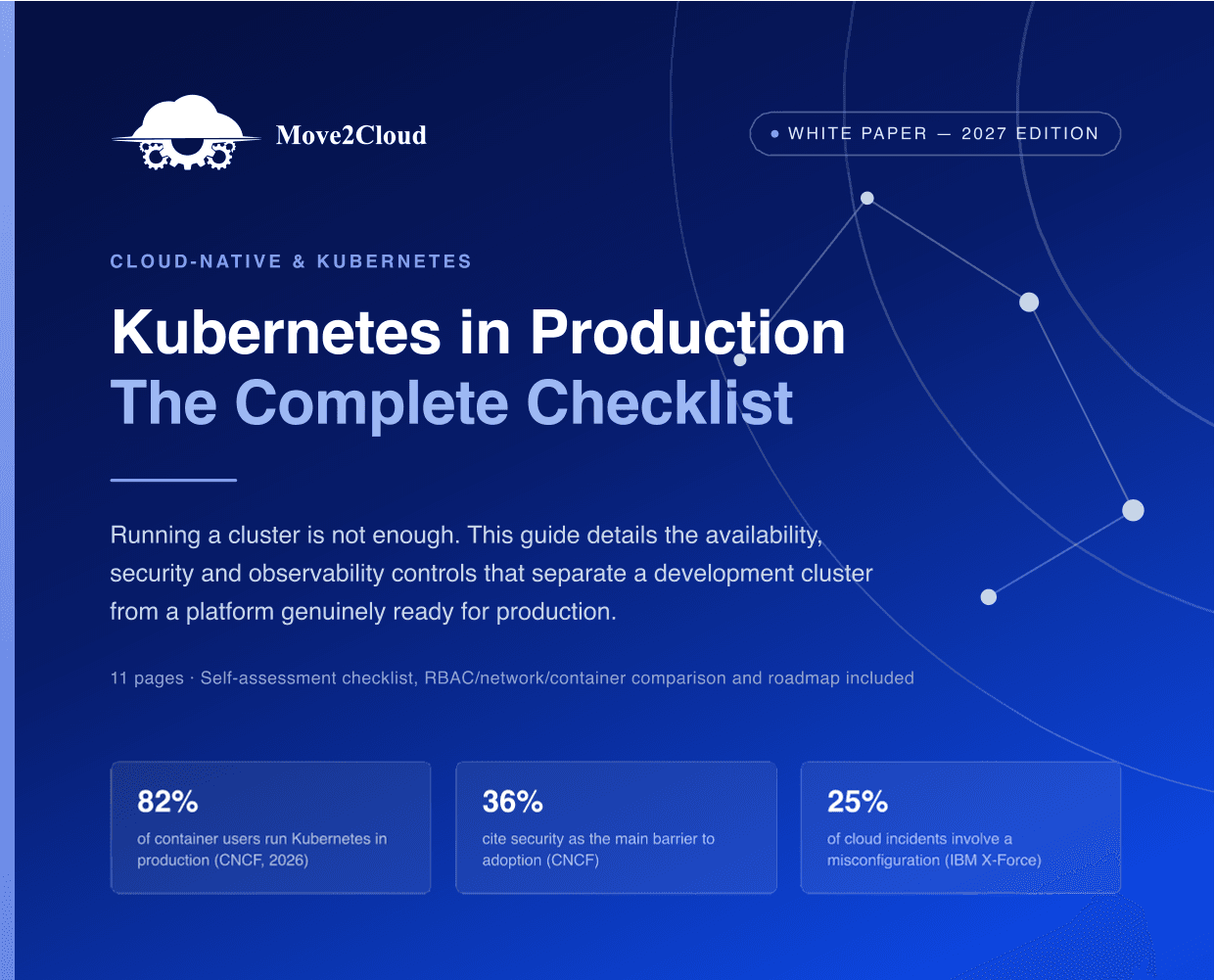
According to the 2026 edition of the CNCF annual survey, 82% of container users now run Kubernetes in production, up from 66% in 2023. But "it runs" and "it's production-ready" remain two different things.
25% of cloud security incidents involve a misconfigured service, according to the IBM X-Force Threat Intelligence Index — not the exploitation of a novel vulnerability.
Availability: the single-replica trap
A service deployed with a single replica has, by definition, zero fault tolerance.
Best practice: at least 3 replicas per critical service, spread across multiple zones, with a PodDisruptionBudget to prevent a node update from taking down too many replicas at once.
Security: RBAC, network, containers
Kubernetes security plays out on three levels: who can act on the cluster (RBAC scoped by namespace), who can talk to whom (explicit NetworkPolicies), and what a compromised container can reach (non-root user, reduced capabilities).
A dashboard or API server exposed without authentication remains one of the most documented misconfigurations.
Key takeaways
- Every critical service runs with at least 3 replicas spread across multiple zones
- A PodDisruptionBudget protects each critical workload during node updates
- RBAC applies least privilege, without broad ClusterRoleBindings
- NetworkPolicies restrict east-west traffic between namespaces
- Metrics, logs, and traces are centralized and alerting
- The persistent volume backup plan has been restored in a test