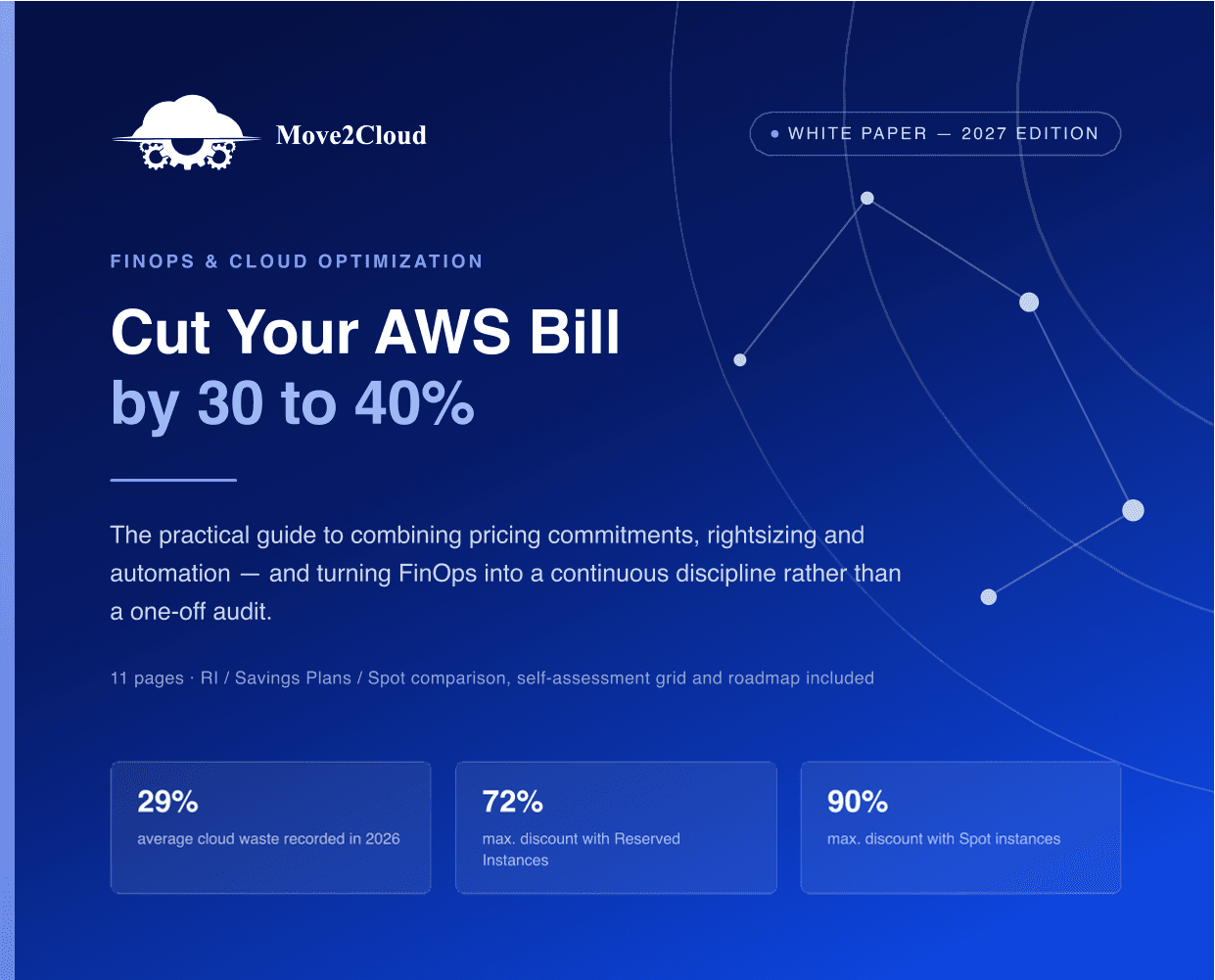
After five straight years of decline, cloud waste rose again in 2026 — with AI as the main driver. According to the 2026 Flexera report, average cloud waste climbed back to 29% of spend, the first increase after five years of steady decline.
The good news for teams who haven't yet structured their approach: the classic levers remain powerful. Combined — pricing commitments, continuous rightsizing, storage cleanup, and automated governance — they typically document a 30 to 40% bill reduction over twelve months.
Pricing commitments: RI, Savings Plans, Spot
Reserved Instances offer up to 72% discount on a 1- or 3-year commitment, Savings Plans offer equivalent flexibility across instance families and regions, and Spot Instances offer up to 90% discount for fault-tolerant workloads (batch, CI/CD, stateless workers).
Common pitfall: deploying Spot on stateful workloads without a recovery mechanism turns a 90% saving into a production incident.
Automate governance instead of reviewing manually
Shutting down non-production environments outside business hours cuts their cost by nearly 50%.
Combined with tools like Compute Optimizer and Cost Anomaly Detection, these automations detect a cost drift within hours rather than at the monthly bill, thirty days too late.
Key takeaways
- Know what share of the bill is on-demand vs. committed (RI/Savings Plans)
- Treat rightsizing as a continuous process, not a one-off audit
- Automatically shut down non-production environments outside business hours
- Use Spot on workloads that are genuinely fault-tolerant
- Set up automatic cost-drift alerting